Key takeaways:
- What it is: board development is the ongoing work of recruiting, training, and evaluating the people who govern your nonprofit.
- The framework: a five-stage cycle for continuous board development, from the first board assessment to ongoing evaluation.
- The plan: audit your board’s skills, set SMART goals, then turn them into an action plan with owners and deadlines.
- The proof: track engagement, governance health, strategic contribution, and resource impact as your core KPIs.
- The tools: a board portal can support onboarding, training libraries, and skills tracking, but it only works alongside a real board development program.
Strong nonprofit board development turns your board of directors into the driving force behind your mission’s success. Yet most nonprofit organizations struggle with disengaged members, skill gaps, and unclear roles that undermine governance. This comprehensive guide delivers actionable solutions to transform your governing body from passive overseers to proactive leaders. You’ll discover:
- A proven five-stage framework for continuous improvement of the organization’s leadership
- Data-backed strategies to boost fundraising, engagement, and compliance
- Vetted resources for cost-effective training and governance tools
- A free customizable board development plan template for your organization’s success
What nonprofit board development is, and why it matters
Nonprofit board development is the intentional, ongoing process of building, nurturing, and optimizing your organization’s governing body. It encompasses recruiting the right talent, clarifying roles, providing training, aligning the board with strategic goals, and evaluating performance.
At its core, board development for nonprofits transforms a group of volunteers into a cohesive leadership force capable of advancing your mission through effective governance, financial oversight, and strategic decision-making.
The real challenges nonprofits face
Despite its importance, many organizations struggle with developing effective boards. According to an advisory firm, Grassi, in its 2024 nonprofit survey, 82% of U.S. nonprofit board members understand their mission and values, but only 48% regularly review profit and loss statements. This disconnect between purpose and financial stewardship typically exemplifies deeper struggles:
- Unclear roles. Current board members often lack a precise understanding of their fiduciary responsibilities versus operational tasks, leading to overreach or disengagement.
- Skill gaps. Boards may lack expertise in critical areas, such as financial management, legal compliance, or fundraising, which limits their strategic impact.
- Low engagement. Spotty board meeting attendance, not following nonprofit board voting procedures, minimal preparation, and passive participation undermine governance.
- Recruitment issues. Finding members who offer both passion and skills, especially in specialized fields such as cybersecurity or risk management, is consistently difficult.
- Weak accountability. Without regular evaluations, underperforming members remain unchecked, which affects the board’s effectiveness and undermines its fundraising potential.
These challenges directly impact organizational leadership and resilience. Boards that fail to prioritize development risk their financial health, compliance failures, and mission drift. According to DonorBox, an online fundraising platform, as much as 70% of nonprofits cite a lack of board involvement in fundraising (DonorBox nonprofit statistics, updated 2025).
The transformative impact of strategic development on nonprofit governance
Organizations that excel at proactive board development usually see measurable results:
- Enhanced governance. Boards provide sharper financial and legal oversight, reducing organizational risk.
- Stronger fundraising. Engaged boards make greater contributions through personal donations and network outreach.
- Strategic agility. Boards aligned with the strategic plan adapt faster to crises and opportunities.
- Mission acceleration. With clear roles and expertise, boards drive progress on organizational goals rather than micromanaging staff.
Simply put, board development is about building a leadership engine that propels your mission forward with nonprofit governance best practices. A strategic approach turns governance from a compliance obligation into your greatest competitive advantage.
Five key stages of nonprofit board development
Building a high-impact board requires a systematic approach. The following interconnected stages will ensure your board evolves alongside organizational needs while staying anchored to your mission:
Stage #1: Comprehensive board assessment
Begin by assessing the health of your current board. Conduct anonymous board self-assessments evaluating individual engagement, collective skills, and alignment with organizational goals. Supplement with SWOT analysis focusing on gaps in financial oversight, diversity, or strategic expertise.
Review board meeting attendance records and committee participation rates. This honest appraisal identifies where development efforts should focus, whether refreshing stagnant board roles or addressing knowledge gaps in legal oversight.
Stage #2: Strategic recruitment planning
Translate assessment insights into an actionable blueprint. Define target competencies (e.g. “HR expertise for staff expansion”), diversity objectives, and term limits. Assign clear responsibilities. For example, the board development committee leads candidate sourcing, while the board chair approves final profiles.
Crucially, align requirements with your strategic plan. If scaling programs is a three-year goal, prioritize recruiting members with growth experience. This typically prevents reactive hiring and ensures new talent directly supports long-term success.
Stage #3: Intentional recruitment and selection
Move beyond personal networks to targeted outreach. For example, you can partner with industry associations or LinkedIn groups to find candidates with niche skills. Structure interviews around mission alignment. Ask “How would your expertise advance our organization’s mission?” rather than focusing solely on resumes.
Include diverse stakeholders (e.g. executive director, committee chairs) in interviews to assess the candidate’s cultural fit. Remember: passion for your cause trumps prestige. A finance professional deeply connected to your work could outperform a disengaged CEO.
Stage #4: Structured onboarding and integration
Effective integration of new board members accelerates their impact. Develop a 90-day roadmap:
- Week 1. Mission immersion (site visits, beneficiary stories)
- Month 1. Governance training (fiduciary responsibilities, bylaws)
- Month 3. Committee assignment with mentor
Formalize expectations through a board commitment agreement (check an example of an agreement from the Bridges Preparatory School) covering fundraising efforts, meeting prep time, and committee work. It’s also important to avoid overwhelming new members. Phase training while encouraging relationships with existing board members through social events.
Stage #5: Continuous evaluation and evolution
Board development never “finishes.” It’s important to put quarterly pulse checks on your nonprofit board meeting agenda after committee meetings, which track engagement and skill application. Annually, measure board performance against KPIs like:
- Percentage of members fulfilling give/get commitments
- Strategic goals, influenced by board input
- Policy updates driven by the board’s effectiveness
Use findings to refresh training, rotate roles, or revisit recruitment criteria, ensuring your board adapts to changing circumstances.
Creating a sound nonprofit board development plan
Follow these steps to build a living board development plan that grows with your organization:
Step #1: Audit current board composition
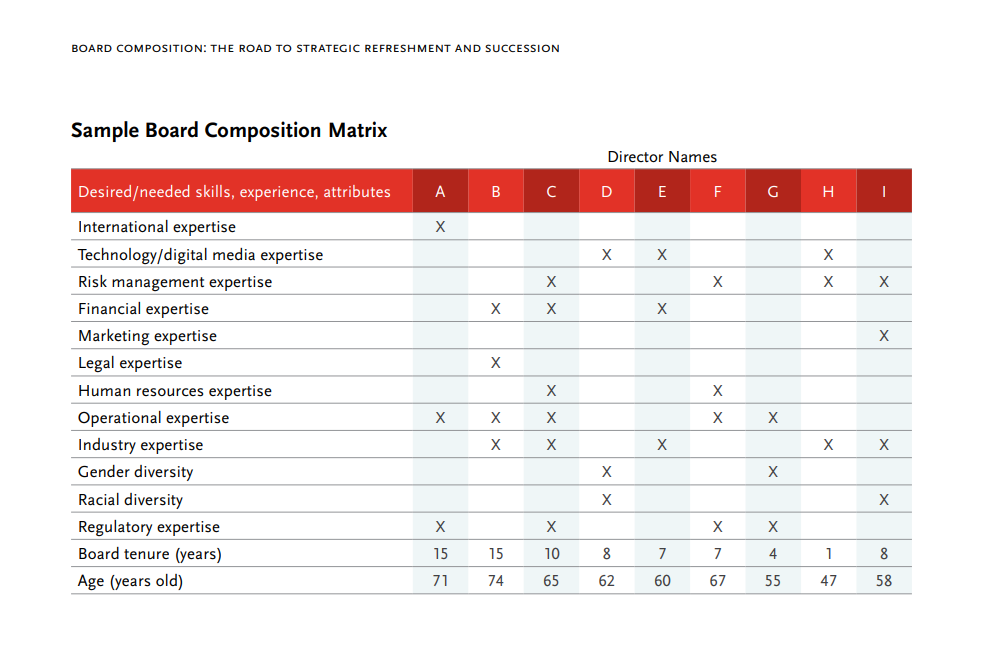
Begin by dissecting your board’s strengths and gaps. Map existing board members against a skills matrix (e.g., finance, advocacy, tech) and demographic criteria. Review term limits, attendance records, and committee contributions.
Compare findings to your strategic plan. If expanding services to new regions, note the absence of geographic or cultural representation. This reveals where recruitment should focus and which board roles need redefinition.
Step #2: Define development goals
Anchor goals to organizational priorities using the SMART framework:
- Specific. “Recruit 2 board members with corporate sponsorship expertise.”
- Measurable. “Achieve 90% board meeting attendance.”
- Achievable. “Train 100% of members on fiduciary duties within 6 months.”
- Relevant. “Align 75% of board skills with 3-year growth objectives.”
- Time-bound. “Complete DEI policy overhaul by Q4.”
Step #3: Build the action plan
Convert goals into tactical steps with timelines and owners. For example:
| Goal | Actions | Owner | Deadline |
|---|---|---|---|
| Improve financial oversight | Train the board on reading financial statements; Establish a finance committee | Treasurer | Q3 2027 |
| Refresh board diversity | Partner with 3 community orgs for recruitment; Revise the nomination criteria | Governance Chair | Q4 2027 |
Additional reading: Check how to take effective nonprofit board meeting minutes in our dedicated article.
Customizing your plan to organizational realities
See how to tailor your board development plan to specific needs:
Budget-driven scaling
With 47% of U.S. nonprofits lacking adequate program funding in 2025 (Forvis Mazars’ 2025 State of the Nonprofit Sector Report, as reported by NonProfit PRO), resource-constrained organizations must prioritize high-impact, low-cost tactics. You could replace expensive consultants with:
- Free expert content. Leverage webinars from state nonprofit associations for essential board training
- Peer-powered growth. Pair new members with experienced directors for shadowing and problem-solving
- Rotational leadership. Build skills organically by cycling committee meetings among members
Mission-specific adaptation
Your organization’s mission directly shapes governance priorities, requiring tailored board development approaches. For example, arts nonprofits might emphasize patron engagement skills, while advocacy groups need policy experts. Key adjustments include:
- Recruitment criteria. Add “lived experience” for community-serving organizations.
- Evaluation metrics. Track advocacy wins (not just funds) for policy-driven boards.
- Training focus. Prioritize cultural competency for international non-governmental organizations (NGOs)
Crisis-response agility
When instability strikes, such as sudden funding cuts, leadership vacuums, or community emergencies, your board development plan becomes a continuity lifeline. Proactively embed these safeguards:
- Scenario-planning protocols. Empower your executive committee to conduct quarterly risk reviews assessing financial vulnerabilities, succession gaps, and operational threats. Document response playbooks for high-probability crises (e.g. “30-Day Survival Plan” for grant losses).
- Emergency skill activation. Audit members’ latent capabilities during onboarding. Identify who can step into interim roles, such as media spokesperson, interim finance lead, or community liaison. Maintain a “crisis competency matrix” for rapid deployment.
Culture integration
Weave your organization’s culture into the plan:
- Include relationship-building rituals (e.g., pre-meeting mission stories).
- Formalize board member expectations in a “Commitment Charter.”
- Design training sessions around organizational values.
Strategic development and governance alignment
When board development and organizational strategy operate in harmony, nonprofits unlock transformative impact. This alignment ensures your board evolves from passive oversight to active leadership, directly fueling mission advancement through informed governance and resource stewardship.
The critical role of strategic planning in board performance
A well-integrated strategic plan serves as the central nervous system of high-functioning governance. Boards that co-create and internalize this plan shift from rubber-stamping decisions to proactively shaping the organization’s trajectory. This manifests in three critical ways:
- Boards make informed decisions rooted in long-term vision rather than reacting to isolated issues.
- They prioritize resources effectively, ensuring fundraising efforts and budgets directly serve impact goals.
- They anticipate risks, transforming financial and legal oversight from compliance exercises into strategic safeguards.
In a 2020 survey of 169 small nonprofit leaders, published by NonProfit PRO in 2022, eighty-six percent of nonprofits with active strategic plans reported revenue growth through grants, donors, and events, confirming that integrated planning turns governance into a growth engine.
How to build a nonprofit board strategy development roadmap
Creating this roadmap requires translating strategic priorities into concrete board development efforts:
Phase 1: Collaborative foundation building
Board members and staff leaders jointly analyze community needs, organizational capabilities, and external trends through facilitated workshops. This shared discovery process ensures buy-in and contextual understanding.
Phase 2: Embed governance non-negotiables
Ensure a way to track how each board member performs. Assign board-specific responsibilities like fundraising targets aligned to program costs, policy modernization timelines, or CEO evaluation protocols.
See how the top nonprofit board portals compare: compare nonprofit board portals.
Additional reading: Learn how to run a nonprofit board meeting effectively in our dedicated article.
Phase 3: Skill-to-strategy mapping
Identify capabilities required for each strategic pillar and assign development actions:
| Strategic Goal | Required Board Skills | Development Action |
|---|---|---|
| Expand to three new regions | Real estate law, capital campaigns | Q3 training with an industry expert |
| Launch digital services | Tech infrastructure literacy | Recruit a chief technology officer (CTO); organize a cybersecurity workshop |
Phase 4: Establish feedback cycles
Implement bi-annual reviews where committees assess strategy progress and recommend adjustments based on community feedback and outcome data. Here is an illustrative example. XYZ Collaborative integrated their “digital accessibility” goal into board development:
- Trained board on the Americans with Disabilities Act (ADA) compliance requirements
- Recruited a tech accessibility director
- Tasked the board with securing pro bono UX audits
- Result: 210% online engagement growth unlocked new funding.
Effective training and resources for nonprofit board development
Transform governance effectiveness using these reputable tools:
| Resource | Description | Cost | Ideal For |
|---|---|---|---|
| BoardSource | Board Support Program offering year-round training, expert consultations, and self-assessment tools for governance excellence. | Custom quote | Organizations needing comprehensive, ongoing governance development |
| Board Academy | 15-week immersive nonprofit board development training program from Virginia’s Center for Nonprofit Excellence, teaching finance, advocacy, and equity-centered governance through case studies. | $1,600 for members; $2,500 for nonmembers | Boards undergoing transformation or strategic pivots |
| Board portal libraries | Secure document repositories that can hold orientation packs, bylaws, and training materials. Compare options in the next section. | Varies by vendor | Boards centralizing training materials and onboarding resources |
Which board portals support board development and onboarding
Board of directors development is mostly about people, not software. Still, several recurring tasks, such as onboarding new members, keeping a training library, and tracking skills and committees, are easier when everything lives in one secure place. This is where board portals for board development earn their keep.
Why do these tasks matter? BoardSource’s 2021 Leading with Intent report found that 49% of chief executives said their boards lacked the right members to build trust with the communities they serve, and only 32% of boards placed a high priority on knowledge of the community served when recruiting. Closing gaps like these starts with a skills audit and structured onboarding.
BoardroomMind compares board development tools for nonprofits independently, and we accept no paid placements. The table below maps common board development needs to features listed on our own review pages. Always confirm current features, onboarding options, and pricing in a demo, because vendors update products often.
| Board development need | Supporting portal feature | Example vendors | Best for |
|---|---|---|---|
| Structured onboarding (90-day roadmap, Stage #4) | Central document repository with access controls for orientation materials, a member directory with custom fields, and templates for repeatable materials | Ideals Board review; OnBoard review | Boards onboarding several new members per year |
| Training and resource libraries (Stage #1, #5) | Secure storage with search, version history, and committee or working-group workspaces | BoardEffect review; Ideals Board review | Boards centralizing governance and training materials |
| Skills-matrix and committee tracking (Step #1 audit) | Board composition and skills evaluation reports, committee management, and task-progress reports per board member | Ideals Board review; Boardable review | Boards running a formal recruitment or skills-gap process |
| Meeting prep and evaluation (Stage #5, KPIs) | Agenda templates and builders, action-item tracking, and analytics dashboards for reviewing outcomes | Boardable review; BoardEffect review | Boards running frequent self-assessments |
Two cautions apply. First, none of these tools replaces the assessment, recruitment, and evaluation work described above. Second, our review pages do not describe a dedicated onboarding checklist for every vendor, so ask each provider to show you how it handles orientation for a new director. Treat any claim you cannot see in a live demo as unconfirmed.
Finally, remember that a portal is only as useful as the habits around it. Boards that already run structured assessments, keep a clear recruitment pipeline, and review progress each quarter get the most from the software, because they know which records they need to keep and who owns them.
How you use the table depends on the size and maturity of your board development program. A small board that is just starting with board member development may only need a secure shared library and a skills matrix. A larger board with several committees will care more about permissions, reporting, and evaluation tools. Whichever describes you, write down your top three board development needs before you book a demo, so the conversation stays on your priorities rather than the vendor’s feature list.
Use these questions to test any portal against your plan:
- Can we upload orientation materials once and assign them to each new director?
- Can we track skills, terms, and committee seats in one view, and export the data?
- Does the portal support board development training for nonprofits through a resource library that every director can search?
- How are self-assessments and evaluation results stored, and who can see them?
- What onboarding and training support does the vendor provide for staff and volunteer directors?
- What does the total cost look like once you add users, storage, and any add-ons?
Organizations with international programs should add one more question: how well does the portal support directors who join meetings and review documents from different time zones and devices? The answer is rarely obvious from a feature list, so ask for a live walkthrough.
See how the top nonprofit board portals compare: compare nonprofit board portals.
Measuring success and improving continuously
Having a nonprofit board development strategy without measurement is like sailing without navigation. You might move, but rarely toward your destination. Tracking progress and refining board governance approaches transforms good intentions into measurable impact.
Essential KPIs for board development
Quantify your board’s effectiveness across four critical dimensions:
- Engagement metrics. Track board meeting attendance, committee participation rates, and preparation time. High-performing boards typically maintain >90% attendance with 70%+ serving on committees.
- Governance health. Monitor policy update completion, risk mitigation actions, and 100% compliance with fiduciary responsibilities.
- Strategic contribution. Measure board influence on organizational goals, such as the percentage of strategic plan milestones achieved with board input.
- Resource impact. Quantify funds raised through board networks, pro-bono expertise secured, and donor connections generated.
Creating a dynamic feedback loop
Build continuous improvement through several nonprofit board management best practices:
- Post-meeting pulse checks. Distribute surveys after each board meeting (e.g. “What decision was most valuable?” “What should we improve next time?”).
- Committee reporting. Require committee meetings to document insights and roadblocks in shared dashboards.
- Stakeholder sounding boards. Quarterly interviews with the executive director, senior staff, and key donors about board effectiveness.
Additional reading: Are nonprofit board meetings open to the public? Check which laws apply to public charities vs private foundations.
Optimizing through assessments
Combine internal and external evaluations for holistic growth:
- Board self-assessments. Conduct annual anonymous reviews rating individual and collective performance against competencies. Use a 1-5 scale for skills like financial oversight or community advocacy.
- External evaluations. Engage governance consultants every three years for unbiased board performance analysis. They can identify blind spots such as unconscious bias in decision-making or outdated bylaws.
Download an actionable nonprofit board development plan template to enhance your proactive board.